

Moving Bed Filtration for Tertiary Wastewater Treatment
Tertiary wastewater treatment plays a critical role in helping UK water companies meet increasingly stringent discharge consents.
This page explains where and why tertiary sand filtration is required in the UK, the regulatory drivers behind it, and how Hydro International’s UK partnership with Brightwork BV enables faster, smarter and more cost‑effective delivery of compliant filtration solutions.
Tertiary wastewater treatment is the final polishing step after secondary biological treatment. Its purpose is to remove remaining suspended solids, nutrients such as phosphorus and nitrogen, and in some cases pathogens, before treated effluent is discharged to the environment.
In the UK, tertiary treatment is required where standard secondary treatment alone is not sufficient to protect environmentally sensitive receiving waters or to meet permit conditions set by the Environment Agency.
Common tertiary treatment technologies used in the UK include sand filtration, reed beds and other constructed wetland systems, UV disinfection for pathogen removal, chemical dosing to precipitate phosphorus, and advanced filtration solutions such as cloth filters.
Sand filtration remains a preferred solution where robust solids removal, process stability and proven long‑term performance are required.
The level of wastewater treatment required at a treatment works depends on:
- The population equivalent (PE) served
- The sensitivity of the receiving waterbody
- Environmental permit conditions issued by the Environment Agency
UK legislation requires tertiary treatment primarily to control nutrient discharges and protect sensitive environments from eutrophication.
Tertiary treatment is typically required where wastewater works serve larger populations discharging to sensitive waters, where Environmental Agency permits are tightened through programmes such as WINEP and AMP8, or when new sensitive area designations are introduced. It may also be needed where existing treatment assets contribute to pollution, or where increased development pressures, particularly in nutrient neutrality catchments, demand higher effluent quality.
Discharge permit conditions are site‑specific, but common limits that drive tertiary treatment include:
- Suspended solids (TSS): typically ≤ 30 mg/l, with tighter limits in sensitive areas
- Total phosphorus (TP): commonly 1.0 mg/l, 0.5 mg/l or lower in sensitive catchments
- Total nitrogen (TN): often ≤ 15 mg/l in designated nitrogen‑sensitive areas, or lower in the case of bathing water directive
- BOD: typically ≤ 10 mg/l
Hydro International solutions for tertiary wastewater treatment
Sand filtration is one of the most widely adopted and proven tertiary treatment technologies, providing reliable removal of fine suspended solids and supporting nutrient compliance where tighter environmental controls apply.
We have a well‑established UK track record in maintenance, refurbishment and optimisation of continuous moving bed sand filters.
Now, through our UK partnership with Brightwork BV, we can also supply new‑build filtration systems with integrated remote smart monitoring to optimise performance and support tighter discharge consents.
Brightwork MBF - modular moving bed sand filter
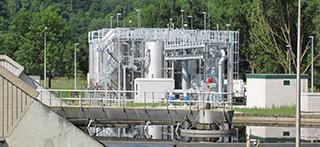
The Brightwork Moving Bed Filter (MBF) is a high‑performance continuous sand filtration system designed for tertiary and advanced wastewater treatment.
Benefits include:
- Modular construction that significantly reduces design and installation time
- Continuous operation without any downtime for backwashing due to the fully hydraulic media washing integrated inside the filter.
- Integrated Sand-Cycle® remote smart monitoring to enable optimised performance and early identification of asset maintenance / issues.
- Simultaneous physical- chemical and biological treatment, eg. for N and P removal.
- Provides consistent effluent quality under variable loading
- Low power requirement results in lower operating costs
Find out more about the Brightwork MBF
Sand-Cycle® remote smart monitoring
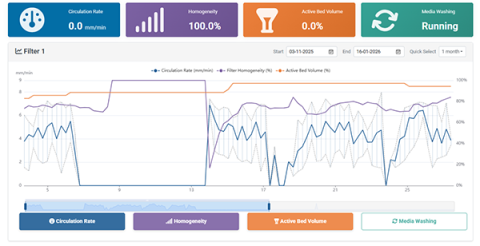
Sand‑Cycle® is an intelligent remote monitoring and control system that enhances the performance of continuous moving bed filters.
By continuously monitoring sand circulation, Sand‑Cycle®:
- Gives operators real-time visibility of filter performance via an online dashboard, making it ideal for unmanned sites
- Helps operators optimise filtration efficiency
- Identifies developing issues early, before compliance is affected
- Enables off‑site performance monitoring via a secure online dashboard
- Can be retrofit into any continuous moving bed sand filter.
Find out more about the Sand-Cycle® remote smart monitoring
Talk to us about your tertiary treatment requirements
Whether you are planning a new tertiary treatment installation, upgrading an existing works, or refurbishing legacy sand filters, we can help you identify the right solution.
Get in touch to discuss your repair, refurbishment or new‑build requirements.